To the untrained eye, it appears to be an impenetrable canopy, pristine wilderness inhabited by isolated tribes and scarcely touched by human hands. Yet looking more closely, specifically at the ground beneath, uncovers a very different reality. Digging into the most remote corners of the Amazon basin reveals an exceptionally fertile soil known as terra preta, or black earth, named for its dark hue. Reaching depths of up to four meters, this substrate extends across thousands of square kilometers, sustaining an array of fruit trees such as passion fruit and papaya.
This soil has lain there for more than five thousand years, and it holds a distinctive secret: meticulous examination reveals mollusk shells, ceramic shards, animal bones, and charcoal. In other words, it is anthropic in origin, a man-made, fertile layer that underpinned the agriculture of our earliest ancestors.
This positive symbiosis between human activity, local economies, and nature is known as an artificial agroforestry ecosystem. It is a practice that gradually fell away with the rise of intensive farming and rural flight. One of the most visible modern consequences is the runaway spread of wildfires: without grazing livestock and native fauna, brush spreads unchecked.
The essence of a sustainable ecosystem lies in benefiting all its inhabitants, including plants, wildlife, and human communities alike, while relying on renewable resources that ensure its long-term survival.
Solar and wind power are critical cornerstones in the shift toward a renewable economy. Yet if there is an energy source that captures genuine harmony with the land and reconnects us with ancestral forestry methods, it is forest biomass.
This approach is on display in Logrosán, a town in the province of Cáceres, where ACCIONA Energía has commissioned a biomass plant that will set the roadmap for forest management and restoration in the coming years. At the same time, the facility generates reliable, clean power to supply more than 73,000 people. Read on to see what forest biomass can do for local communities and the wider environment.
Rural depopulation has been a fixture of public debate in Spain over the past decade. This phenomenon, which also affects rural regions worldwide, reflects the steady emptying of the countryside. Without an economic future, small towns drift toward extinction. How can we breathe new life into them? The clean energy economy, alongside innovative forms of tourism and agriculture, is one of the most effective levers for revitalizing this social fabric.
If a picture is worth a thousand words, a single statistic can be just as telling: in the 1950s, Logrosán had more than six thousand residents. Today, its population barely reaches two thousand. Yet these residents and the land they inhabit hold immense promise for a renewed economy.
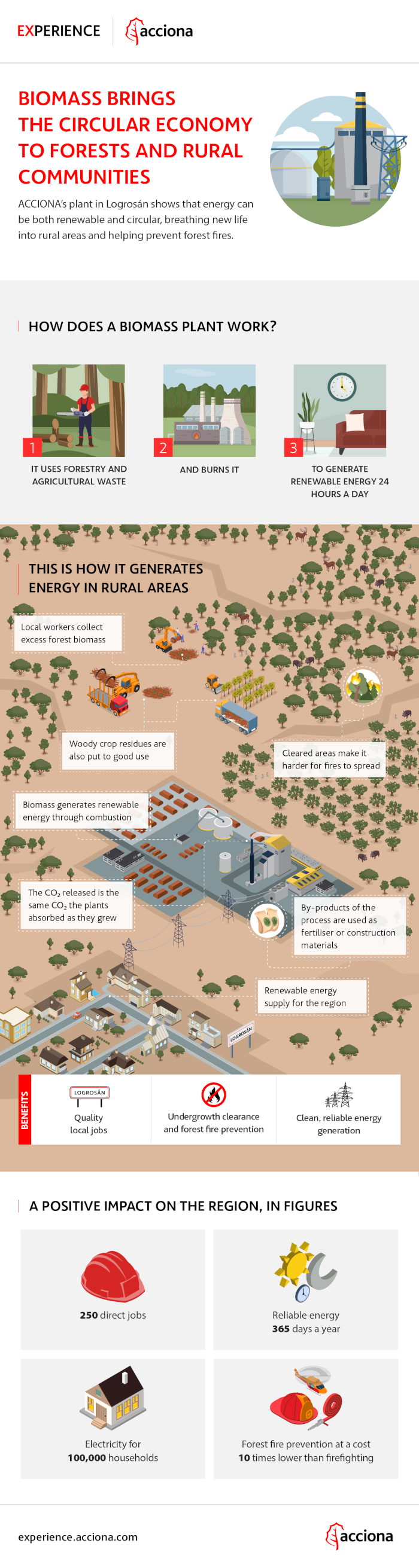
That opportunity led to the construction of a forest biomass plant in the municipality, creating more than nine hundred direct and indirect jobs. These include the crews out gathering raw material in the hills and the technicians operating the plant day in, day out to geerate electricity.
At the same time, local woodland owners benefit directly: beyond seeing their land better managed against the threat of fire, they receive payment for the collected biomass.
This is where the “firefighters” of the biomass sector step in. These two hundred workers head into the hills every week to clear overgrown brush without harming healthy stands, gathering feedstock for clean energy production. Preventing a wildfire is estimated to cost one-tenth of what it takes to put one out. "
Without grazing herds, and during years when heavy rains give way to sweltering summers, woodlands quickly turn into tinderboxes. In 2025 alone, wildfires devastated more than one million hectares across the European Union, according to EFFIS data. The combination of soaring temperatures and overgrown stands has given rise to sixth-generation wildfires: true firestorms that, in many cases, can no longer be contained by conventional suppression methods.
This is where the “firefighters” of the biomass sector step in. These two hundred workers head into the hills every week to clear overgrown brush without harming healthy stands, gathering feedstock for clean energy production. Preventing a wildfire is estimated to cost one-tenth of what it takes to put one out. In clearing this fuel from the woods, their work does precisely that while generating electricity. Europe’s forested area is steadily expanding, but it will take many hands like theirs to keep those woodlands in good health.
Crucially, this is not only renewable power; it operates irrespective of weather conditions or the time of day, acting as a steady, dependable power source that helps balance the electricity grid.
Biomass brings a distinct edge to the energy mix: it delivers firm, reliable, and dispatchable power capable of complementing other renewable sources like solar and wind, all while putting local resources to work and bolstering energy independence.
In environmental terms, the deployment of this renewable facility in Logrosán will avoid emissions equivalent to four times the carbon-absorption capacity of Monfragüe National Park. The combustion process is carbon-neutral, releasing only as much CO2 into the atmosphere as the biomass absorbed during its growth cycle. Advanced filtration systems also ensure that particulate matter and other air pollutants never escape into the atmosphere.
Biomass brings a distinct edge to the energy mix: it delivers firm, reliable, and dispatchable power capable of complementing other renewable sources like solar and wind, all while putting local resources to work and bolstering energy independence."
The journey of forest biomass does not end in the boilers. The combustion ash produced by the plant can be reclaimed across a variety of uses: from acting as an ingredient in low-carbon concrete and other green building materials to producing fertilizers rich in phosphorus and potassium. This represents one of the most advanced examples of a zero-waste circular economy: land stewardship, renewable power generation, and byproduct recovery united in a single loop.
Alongside the use of ash, there is another opportunity: leveraging the biogenic CO₂ generated at biomass plants. Unlike fossil-derived carbon, this CO₂ comes from organic matter that previously absorbed it from the atmosphere as it grew. ACCIONA Energía is already exploring different initiatives to capture and condition this CO₂ and combine it with renewable hydrogen, with the aim of giving it a new use in the production of synthetic fuels such as e-methanol.
Thousands of years ago, Amazonian communities learned to cultivate their jungle ecosystems sustainably, securing their livelihoods while respecting the land. Today, while modern technology separates us from their methods, the biomass crews out tending the woodlands recapture something of that mindset.
Ultimately, the goal is not to force heavy-handed interventions onto an ecosystem, but to inhabit it responsibly, understanding our role in preserving both its ecological integrity and its economic vitality. Forest biomass stands out as one of the most practical avenues for forging an enduring alliance with nature in the century ahead.